Blooming Spirit
A Violets in Bloom publication · Issue
11
Womb Healing: The Ancient Wisdom They Tried to Silence, and Why It's Rising Again
Byline
By Ava Adames
Issue
November / December 2026 · Issue
Womb Healing: The Ancient Wisdom They Tried to Silence, and Why It’s Rising Again
BLOOMING SPIRIT MAGAZINE · FEATURE 11
By Ava Adames
The womb is not only a cradle of life. It can also become a place where we listen, soften, remember, and return to ourselves.
Throughout history, the womb has been understood as more than an organ. It has been honored as a center of creation, intuition, sexuality, grief, renewal, and power.
Across many cultures, reproductive knowledge was carried through relationships: between mothers and daughters, elders and apprentices, midwives and families, healers and the communities they served. Some of this knowledge was medical. Some was spiritual. Much of it was both.
As an energetic womb practitioner, I approach this subject with reverence, and with care. I do not believe we need to romanticize the past to reclaim meaningful wisdom. We can honor what was nourishing while also asking honest questions about history, safety, cultural ownership, and evidence.
At a Glance
- Womb-centered practices have appeared in many distinct cultural and religious traditions.
- These traditions should not be blended into one universal story.
- Energetic womb work can support reflection, mindfulness, emotional integration, and nervous-system care, but it does not diagnose or treat medical conditions.
- Reclaiming the womb can be gentle, informed, and deeply personal.
A question to carry with you:
What does my body need from me today: attention, rest, medical care, grief support, movement, or simply a quiet hand placed over my lower belly?
WOMB HEALING ACROSS THE WORLD
🌺 Africa: Midwives, Ancestral Care, and Community Knowledge
In many African societies, midwives held important roles as birth attendants, herbal practitioners, counselors, and community healers. Their work often extended beyond labor itself to include pregnancy support, postpartum care, massage, ritual bathing, plant knowledge, and guidance for families.
Research on Mande communities in Sierra Leone, traditional midwives in Cameroon, Yoruba birth attendants, Hausa women healers, and Shona midwives in Zimbabwe shows that reproductive care was shaped by local knowledge, spiritual belief, social relationships, and practical skill. These were not one single “African tradition,” but many specific traditions rooted in particular peoples and places.
Some African and African-diasporic communities also used herbal baths, fumigation, or postpartum cleansing practices.
Ohio State University Press: Safe in a Midwife’s Hands offers a deeper look at African midwifery, plant knowledge, massage, and ritual care.
🕯️ Europe: Wise Women, Herbal Lore, and the Witch Hunts
In medieval and early modern Europe, women known as wise women, healers, herbalists, and midwives held practical knowledge about herbs, childbirth, menstruation, and household medicine. But the popular story that the witch hunts were simply a campaign against midwives is too narrow.
Across roughly three centuries, witchcraft accusations were shaped by religious conflict, political change, property disputes, local tensions, fear, poverty, and scapegoating. Women made up the majority of those accused, although men were also prosecuted. Historians generally estimate that approximately 40,000 to 60,000 people were executed for witchcraft in Europe, with estimates varying by scholar and region, not the millions sometimes repeated in popular storytelling.
Some healers and midwives were certainly accused. But not every person executed was a healer, and the full history deserves more care than a single dramatic explanation.
The silencing was real. So were the many causes.
🌿 Asia: Daoist Inner Alchemy and Ayurveda
In some Daoist traditions of female internal alchemy, the body was understood through ideas of jing, qi, blood, breath, and transformation. Scholars describe practices involving meditation, visualization, breath regulation, and attention to the lower abdomen or chest. These teachings belong to particular historical and religious lineages; they should not be reduced to modern wellness language.
Ayurveda, the South Asian medical tradition, contains its own extensive frameworks for reproductive health, including the concepts of yoni, garbhashaya, doshas, massage, and nourishment. Practices such as abhyanga are described in Ayurvedic literature and contemporary practitioner settings, but they should not be self-administered from an internet article. This kind of care belongs in conversation with trained practitioners and qualified medical support.
Within Shakta traditions, Shakti refers to divine power or creative energy. I hold that language symbolically: as an invitation to remember that our creativity, vitality, and self-trust deserve nourishment.
🌸 The Americas: Moon Time, Song, and Community
Indigenous nations across North and South America have distinct teachings about menstruation, birth, plants, song, drumming, smoke, and ceremony. There is no single Indigenous womb tradition.
In some Anishinaabe, Métis, Haudenosaunee, Cree, Inuit, and other community contexts, menstruation has been approached as moon time: a period associated with rest, spiritual responsibility, reflection, or heightened power. Some communities used separate spaces or moon lodges, while others practiced different forms of retreat or support.
These practices were not universally experienced in the same way. For some women, seclusion offered rest and respect. In other settings, menstrual restrictions could also be limiting. The meaning depended on the nation, the time period, the community, and the woman’s own experience.
When I speak about moon lodges, I want to center Indigenous voices and encourage learning directly from Indigenous educators and communities, not borrowing sacred practices as decorative wellness language.
🧿 The Middle East: Goddesses, Rebirth, and the Modern Red Tent
Inanna of Mesopotamia and Isis of Egypt were powerful goddesses associated with sexuality, fertility, motherhood, protection, death, and rebirth. Their temples, stories, images, and priestly cultures are historically documented.
What is not clearly documented is the modern idea that ancient priestesses gathered in red tents for menstrual seclusion in honor of Inanna or Isis. The contemporary red tent movement is a modern spiritual and feminist reimagining, inspired by broader goddess symbolism rather than a proven ancient institution.
That distinction matters to me. Myth can be meaningful without being presented as archival fact.
THE SILENCING OF THE WOMB
Patriarchal systems have often controlled women’s bodies through law, religion, medicine, family structures, and shame. Menstruation has been called dirty. Sexuality has been policed. Fertility has been treated as a social obligation. Birth was gradually moved away from many community-based midwives and into increasingly clinical systems.
Modern medicine has also brought lifesaving knowledge, safer surgery, antibiotics, and reproductive care. The answer is not to reject medicine. The invitation is to build a relationship with care that includes informed consent, dignity, cultural humility, and the right to be heard.
Many women reach midlife carrying complicated feelings about their bodies: grief after pregnancy loss, fear around illness, pain, infertility, pelvic tension, menopause, sexual trauma, or years of disconnect from their own sensations.
The body may carry memories and sensations, but that does not mean trauma is literally stored in the uterus. Emotional and sexual trauma deserve skilled mental-health support, not spiritual bypassing.
If you are experiencing irregular cycles, chronic pelvic pain, heavy bleeding, infertility, endometriosis, PCOS, fibroids, or any other reproductive concern, please consult a qualified healthcare provider.
Blooming Spirit Magazine Editorial & AI Disclosure: This feature was prepared with AI-assisted research, organization, and drafting support. Ava Adames provided the creative direction, source review, personal perspective, and final editorial approval.
THE REAWAKENING
The reawakening does not need to be loud.
It may look like placing one hand over your lower belly and breathing without trying to fix anything. It may be Reiki, sound, gentle movement, aromatherapy, meditation, journaling, prayer, or a conversation with a trusted practitioner.
In my work, I use energy healing Reiki, sound, breath, guided mindfulness and meditation, and intentional presence. I hold space for the emotional and energetic layers of a person’s experience. I do not diagnose, prescribe, or treat medical or mental-health conditions.
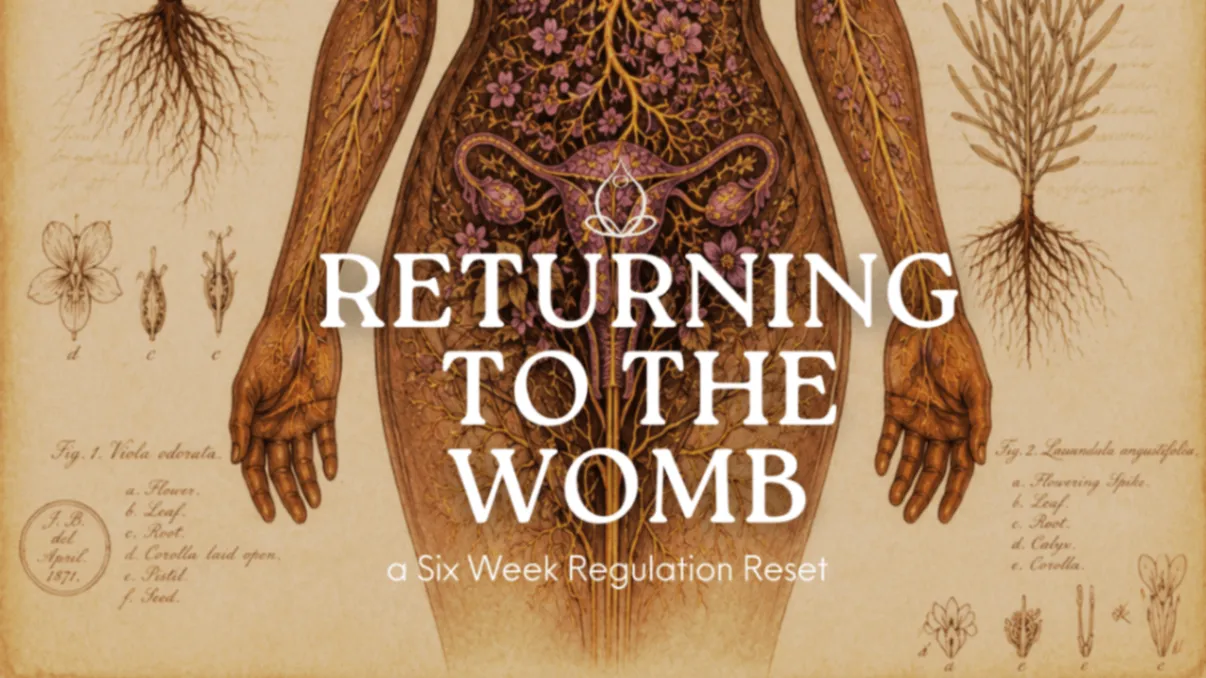
My Returning to the Womb six-week virtual regulation reset begins January 3 with Cohort 3. This is not a promise to erase your history or “reset” your biology. It is a gentle container for nervous-system awareness, self-trust, reflection, and reconnection. View the schedule and offerings.
READING & FURTHER REFLECTION
One voice I want to name within this reawakening is WombWise – Womb Wisdom & The Works: A Culturally Rooted Menopause Guide with Reflections for Black & Caribbean Women by Shawnafi Dynesen Anderson.
Shawnafi Dynesen Anderson is a Jamaican Maroon from St. Thomas, Jamaica, an author, mother, and the founder and formulator of the botanical wellness company Zyzven Naturals. She shares that the plants and traditional preparations she grew up around were part of everyday life, shaped largely by her grandmother, and that she later studied Medical Herbalism.
What I value about this book is how clearly it is written for Black and Caribbean women. It bridges traditional herbal wisdom with guided reflection and journaling, and it was written because Anderson repeatedly saw Black women — especially women from Caribbean backgrounds — arriving at menopause without the information, language, or support to understand what is happening in their bodies.
Her central message feels especially important here: menopause itself is a single day, but the way it has been packaged and sold often frames it as the end of a woman’s value. She wrote the book to challenge that narrative.
To me, that is exactly why this book belongs in a feature about womb wisdom, memory, and the reclamation of women’s health knowledge. It holds hormonal transition and cultural silence together, and it offers one specific, grounded voice in a conversation that has too often been shaped without Black and Caribbean women in the room.
A GENTLE PRACTICE OF RETURN
Try this for three minutes:
- Place one hand on your heart and one hand over your lower abdomen.
- Notice the surface beneath you.
- Let your exhale lengthen naturally, without forcing it.
- Ask: What am I feeling? What am I needing? What support would be wise today?
- End with: “I am allowed to listen without having every answer.”
This is not a cure. It is a pause.
SAFETY, SUPPORT, AND CARE
This article is for spiritual wellness and reflection. It is not medical or gynecological advice, diagnosis, or treatment.
- Reiki and energy work are complementary practices, not replacements for medical or psychological care.
- A qualified therapist is the appropriate support for processing sexual trauma, abuse, or complicated grief.
- If you or someone you know is in emotional distress, experiencing a mental-health crisis, or having thoughts of suicide, call or text 988 for free, confidential support through the 988 Suicide & Crisis Lifeline, available 24/7 in the United States.
FINAL THOUGHTS
The womb can be a physical organ, a symbolic center, a place of memory, and a language we use to speak about creation and change.
It can hold stories of motherhood and non-motherhood, sexuality and silence, loss and renewal. It can remind us that blooming is not always tidy. Sometimes it is a messy, beautiful process of learning how to belong to ourselves again.
I do not believe we have to return to an imagined past.
I believe we can move forward with discernment: honoring midwives, respecting living traditions, listening to medical evidence, and creating new rituals rooted in consent and care.
If your womb is calling, listen.
Perhaps the message is not urgent. Perhaps it is simply asking for room.
Room to remember.
Room to release.
Room to rest.
Room to hear your own internal light.
SOURCES & FURTHER READING
- Encyclopaedia Britannica: Witch Hunt
- Oxford Academic: Witchcraft and Witch Trials
- Ohio State University Press: Safe in a Midwife’s Hands
- Medical University of South Carolina: African American Midwifery Archives
- Elena Valussi, University of British Columbia: Female Alchemy Tradition
- Brill: Scholarship on Women in Daoism
- WombWise – Womb Wisdom & The Works: A Culturally Rooted Menopause Guide with Reflections for Black & Caribbean Women by Shawnafi Dynesen Anderson
- ORACC: Inanna/Ishtar in Ancient Mesopotamia
- 988 Suicide & Crisis Lifeline
About the Author
Ava Adames started writing in the fourth grade. Daily stories in her diary. Today she writes blogs, haikus, and short stories with a sprinkling of magic. She is the founder of Violets in Bloom.
By Ava Adames
Pull quote
The womb is not only a cradle of life. It can also become a place where we listen, soften, remember, and return to ourselves.