
Blooming Spirit
A Violets in Bloom publication · Issue
09
Candle Activations: A 7-Day Ritual for the Things You've Been Avoiding
Byline
By Ava Adames
Issue
November / December 2026 · Issue
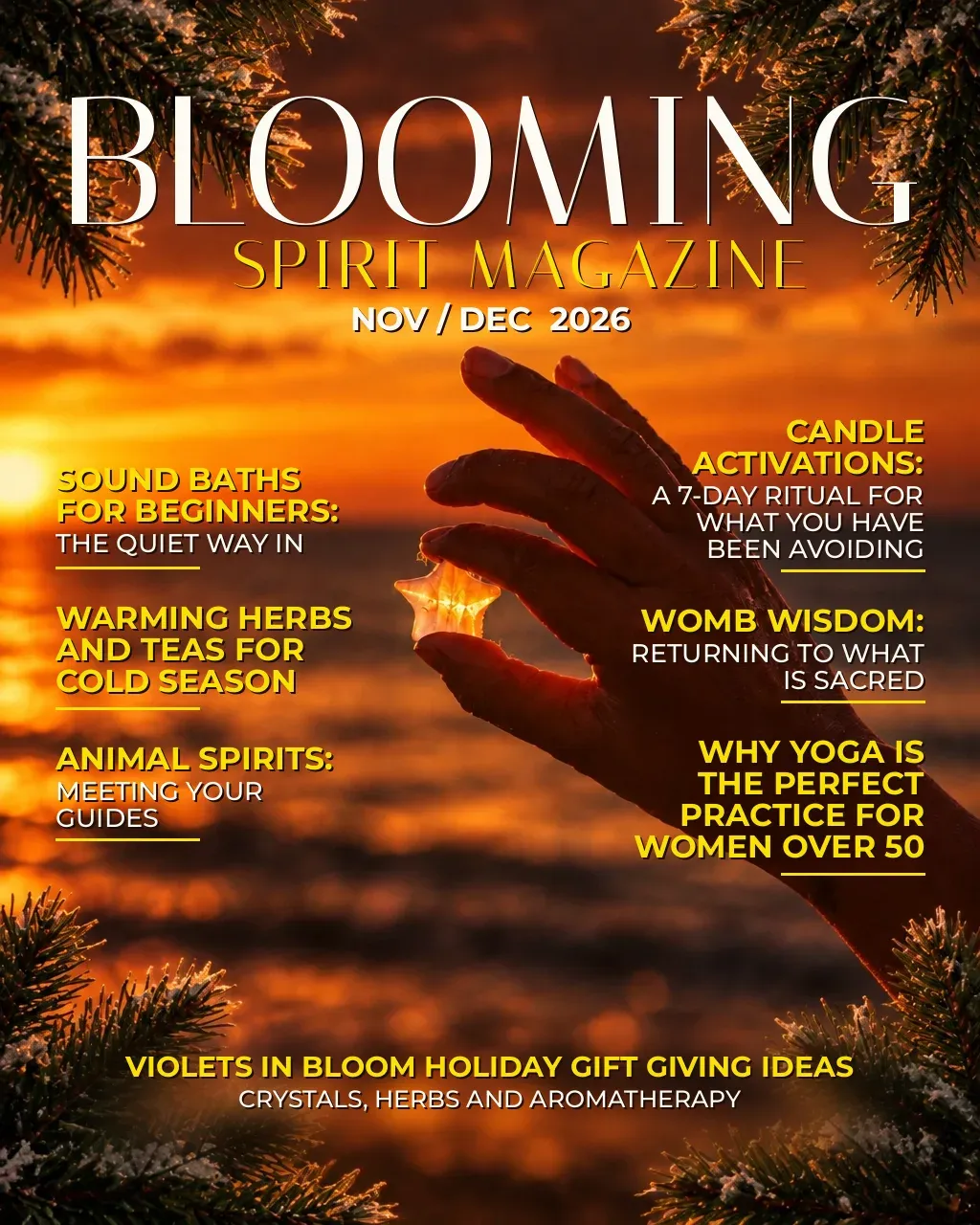

Candle Activations: A 7-Day Ritual for the Things You've Been Avoiding
BLOOMING SPIRIT MAGAZINE · FEATURE 09
By Ava Adames
ONE CANDLE. ONE PAGE. ONE STONE.
As October gives way to November, you might not need a complicated ceremony. You might need only a small, intentional pause.
One candle to mark the present moment.
One page to tell the truth gently.
One stone to hold as a reminder that change can be slow, grounded, and real.
May this threshold offer you quiet, not emptiness, but room. Room to remember. Room to release. Room to hear your own internal light.
At a Glance
- Time: 10–15 minutes a day
- You’ll need: One candle, one page, one stone, matches, and a glass of water
- Focus: Turning toward one avoided truth in small, manageable doses
- Pace: Repeat a day, rest, or stop whenever your body asks
- Purpose: Reflection and meaning-making, not diagnosis, treatment, or forced resolution
Avoidance Is Not a Character Flaw
There may be something you have been circling for weeks, months, or even years.
A difficult conversation. A decision. A room that needs clearing. A grief that has not found language. A letter you have not opened. A truth that feels too large to hold all at once.
Avoidance does not always mean laziness, denial, or failure. Often, it is a protective response. Your nervous system may be trying to keep you away from something that once felt unsafe, painful, overwhelming, or simply beyond your available capacity.
The American Psychological Association’s definition of avoidance coping describes it as disengaging from a stressful situation rather than addressing it directly. The APA also notes that avoidance can sometimes reduce distress temporarily and prevent anxiety from becoming overwhelming.
That nuance matters.
Avoidance may have helped you survive a season. The invitation now is not to shame it away, but to ask with compassion:
What is my nervous system trying to protect me from?
What would feel like a small enough step today?
Research on anxiety and avoidance suggests that persistent avoidance can maintain fear and distress over time. A review published in the Journal of Anxiety Disorders also emphasizes that avoidance is not always harmful; its meaning depends on context, flexibility, and whether it supports or restricts a person's life. Read “Rethinking Avoidance” through the National Library of Medicine.
This seven-day practice is not exposure therapy. It is not a substitute for therapy, trauma treatment, grief counseling, or medical care. It is a gentle reflective ritual with permission to pause.

The Candle Activation Ritual
In this practice, “activation” means bringing deliberate attention to an object and an intention. The candle does not perform a treatment or guarantee an outcome. Its flame gives the present moment a visible center.
1. Prepare the Space
Clear a small, stable surface.
Place nearby:
- One candle
- One page or journal
- One stone
- Matches or a lighter
- A glass of water
- A soft blanket, if comfort would help
Keep the candle on a heat-safe surface, away from paper, fabric, curtains, drafts, children, and pets. Let the room feel contained and kind.
2. Light the Candle and Pause
Light the candle only when you can remain present with it.
Take three unhurried breaths. Notice the chair beneath you, your feet on the floor, and the temperature of the room.
Name the present moment out loud or write it down:
“I am here. It is __________. I feel __________. I do not have to solve everything tonight.”
3. The One Page: Write the Truth Gently
Let the page hold what your mind has been carrying.
You do not need to write beautifully. You do not need to explain yourself. A few honest words are enough.
Choose one prompt:
- What am I circling around without landing on?
- What would I write if no one would read it?
- What am I afraid would change if I stopped avoiding this?
- What is the smallest true sentence I can write today?
- What part of this feels tender, complicated, or unfinished?
- What support would make the next step feel more possible?
- What am I willing to leave for another day?
If your body begins to tighten, look around the room and name five things you see. Return to the floor beneath you. Close the page. Stopping is part of the practice.
4. The One Stone: Hold the Reminder
Hold your stone in one or both hands.
Notice its temperature, weight, edges, and texture. Breathe naturally. You might say:
“I can move slowly and still be moving.”
The stone is a reminder, not a treatment. Its mineral composition and physical presence offer something tangible for your attention. Any emotional or spiritual meaning belongs to your personal relationship with it; no crystal can promise to change your health, circumstances, or future.
5. Close the Ritual
Blow out the candle before leaving the room. Close the page. Place the stone somewhere you will see it tomorrow.
Then say aloud or think:
“I have met this moment with care. I can return when I am ready.”

The Seven-Day Arc
You may use one candle for all seven days or choose among Ava’s handcrafted 7-Day Meditation/Prayer Candles. Repeat any day. Rest for a day. Begin again without calling it failure.
Day One: Notice
Write one sentence naming what you have been avoiding.
Action: Do not analyze it. Simply let the sentence exist on the page.
Day Two: Listen
Place one hand over your chest or abdomen, if comfortable.
Prompt: What feeling appears when I imagine turning toward this?
You do not need to make the feeling disappear.
Day Three: Separate
Write two columns:
- What is in my control
- What is not in my control
Action: Circle one small item in the first column.
Day Four: Make It Smaller
Break the avoided matter into the smallest possible next step.
That may be finding a phone number, opening an email, placing one item in a donation bag, or writing three words for a conversation.
Action: Name the step without completing it if completion feels too soon.
Day Five: Invite Support
Avoidance often grows in isolation.
Prompt: Who, what, or where could offer steady support?
This may be a trusted friend, therapist, physician, spiritual director, support group, or practical resource.
Day Six: Practice the First Movement
Take one action that lasts no more than five minutes.
Set a timer if helpful. Stop when the timer ends.
Action: Let “enough for today” be a complete sentence.
Day Seven: Integrate
Read what you wrote, only if that feels supportive.
Prompt: What did I learn about my pace, my needs, or my capacity?
Close by writing one sentence of gratitude for the part of you that kept trying to protect you.
Pairing the Candles With Crystals
Choose a stone for its physical presence first, then allow personal symbolism to follow.
- Pure Relaxation Sensation + Amethyst: Amethyst is a purple variety of quartz, colored primarily by trace elements and irradiation. In spiritual practice, it is often associated with quiet reflection and intuitive listening.
- Energy Rising + Red Jasper: Red jasper is an opaque, iron-rich variety of microcrystalline quartz. Its weight and earthy color can serve as a symbolic reminder of steadiness and forward movement.
- Grounded Gratitude + Moonstone: Moonstone is a feldspar mineral known for its soft adularescence, or floating light effect. Many people associate it with cycles, transition, and emotional reflection.
You might also reach for smoky quartz, black tourmaline, selenite, or obsidian. Explore Violets in Bloom’s tumbled stones or Crystal Guide to learn more about mineral identity and care.
Whether you are searching for crystals for abundance, looking for a crystal shop near me, or visiting our holistic wellness studio, choose the stone that feels physically comfortable in your hand. If you are part of Bloom Rewards, this can also be a lovely moment to make your next selection slowly and intentionally.
Safety Before You Begin
Candle safety
- Never leave a burning candle unattended.
- Keep it away from children, pets, curtains, paper, bedding, and drafts.
- Trim the wick according to the candle maker’s instructions.
- Burn on a stable, heat-safe surface.
- Never move a lit candle.
- Extinguish it before leaving the room or going to sleep.
- Stop burning before the flame reaches the bottom of the container.
- Consider a flameless candle if an open flame is not appropriate for your space.
The National Fire Protection Association reports that candles remain a significant source of home fires and recommends extinguishing them before leaving a room or going to bed.
Essential-oil safety
- Do not apply essential oils to your skin undiluted.
- Keep oils away from your eyes and do not ingest them.
- Use caution around pets and infants.
- Ask a qualified healthcare professional before using essential oils during pregnancy, while breastfeeding, or if you have a respiratory condition.
- Bergamot and other citrus oils may cause photosensitivity when applied to skin; a candle’s aromatic use is not the same as topical use.
- Discontinue use if the scent causes headache, coughing, nausea, or irritation.
This ritual is for reflection, mindfulness and meditation, spiritual wellness, and personal meaning-making. It is not medical or psychological advice, diagnosis, or treatment. If avoidance is connected to trauma, panic, OCD, complicated grief, or distress that feels unmanageable, please work with a qualified mental health professional. In the United States, call or text 988 for the Suicide & Crisis Lifeline.

A Soft Invitation
You do not have to resolve everything in seven days.
You only have to practice meeting yourself with a little more honesty and a little less force. Light the candle when it is safe. Write one true sentence. Hold one stone. Let the next step remain small enough for your nervous system to recognize it as possible.
What would change if you stopped asking yourself to be fearless, and began asking what would help you feel supported?
Sources and Further Reading
- American Psychological Association Dictionary: Avoidance Coping
- Hofmann and Hay, “Rethinking Avoidance”
- NCCIH: Aromatherapy
- National Fire Protection Association: Candle Safety
- 988 Suicide & Crisis Lifeline
Ava Adames started writing in the fourth grade. Daily stories in her diary. Today she writes blogs, haikus, and short stories with a sprinkling of magic. She is the founder of Violets in Bloom.
Explore more reflective practices, seasonal rituals, and mind-body-spirit guidance in Blooming Spirit Magazine.
Pull quote
What would change if you stopped asking yourself to be fearless, and began asking what would help you feel supported?